Etiuda & Anima23 to 29 November 2012, Anima competition jury with Borivoj Dovniković Bordo (chair), Alfio Bastiancich, Janusz Korosadowicz and Marta Pajek, Krakow
Screenings and broadcasts
Screenings, premieres, broadcasts and appearances, oldest first.
Vielä pikkuisen piirrettyä elokuvaa1983, a 37-minute survey of Finnish animation by Juho Gartz and Lauri Tykkyläinen, with Marjut among the animators interviewed; shown again at Cinema Orion, Helsinki, on 15 October 2014
Some Protection, broadcast on Channel 4 in February 1990 under the series title In Justice, renamed at the last minute because the BBC had a drama called Blind Justice (The Lost Continent)
Urpo and Turpo, cinema premiere at Kino Engel 2, Helsinki, 27 April 1996, distributed by Cinema Mondo; festival screenings the same year at Espoo Ciné, Copenhagen, Lübeck, Sodankylä and Oulu (Elonet)
Urpo and Turpo, first broadcast on YLE TV1, 14 September 1996
Dope Sheet1997 to 1999, Channel 4's late-night animation magazine: with Marjut in one of its fifteen episodes
Cartoon Sushi1997 or 1998, MTV and Teletoon: an episode with her work among films by Bill Plympton, Raimund Krumme and Juan Pablo Zaramella
Janela da Alma2001, a Brazilian feature documentary on seeing by João Jardim and Walter Carvalho, with nineteen interviewees including José Saramago, Wim Wenders, Agnès Varda and Oliver Sacks; Marjut talks about her squint and Many Happy Returns
Learned by Heart, at Animateka, Kinodvor, Ljubljana, 7 to 13 December 2009, in the Finnish focus programme
Urpo and Turpo, on Yle Teema, Animaatioarkiston aarteita, 7, 10 and 12 October 2014: Urpo ja Turpo näyttelevät in a package marking a hundred years of Finnish animation
Some Protection, The Stain: Paul Wells, Understanding Animation1998, Routledge. Some Protection is the worked example of the documentary tendency in animation (page 27): the film "documents the deep anxiety of Josie O'Dwyer, using her own troubled recollections of abuse, petty crime and the brutalities of imprisonment, and effectively shows the perception of reality as it is experienced by O'Dwyer. Arguably, this is a more truthful reality and one which is only possible to document in animation." The Stain appears in the chapter on the feminine aesthetic (page 199). The book spells her name Rimmenen throughout, index included
I'm not a Feminist, but…, Some Protection, The Stain: Jayne Pilling (ed.), Women and Animation: A Compendium1992, British Film Institute. A three-page profile (pages 37 to 40) on the making of I'm not a Feminist, but… with Christine Roche, on Some Protection, and on The Stain, of which Pilling writes: "it's rare to meet someone who's seen The Stain who hasn't been, quite simply, knocked out by it"; plus a filmography entry. The source of several quotations on this site
The Stain: Jayne Pilling (ed.), Animating the Unconscious: Desire, Sexuality and Animation2012, Wallflower Press. Three pieces on the film: Karen Beckman's essay Mixing Memory and Desire (pages 187 to 192), which finds that "Rimminen and Roche draw on animation's capacity to exceed live-action's depiction of the world as it is to depict the possibility that deformation might mutate into transformation"; interviews with Marjut Rimminen and Christine Roche (193 to 198); and Roche's sketchbooks (199 to 207). Ruth Hayes returns to the film on page 216. Reviewed by Ben Mitchell in Skwigly
The Stain: Stephen Holden, Animated Inventiveness21 January 1994, The New York Times, reviewing The 24th International Tournée of Animation at the Angelika Film Center, where The Stain was the longest film: "Created by Marjut Rimminen and Christine Roche, The Stain tells a troubled family history from the dual perspective of identical twins. Its characters and images, although inventive, lack the psychological resonance to bring to life a fable that has an abrupt and shocking ending." Reprinted in The New York Times Film Reviews, 1993–1994
Learned by Heart, Some Protection: Annabelle Honess Roe, Animated Documentary2013, Palgrave Macmillan. Learned by Heart is a case study of the chapter Animated Memories (pages 146 to 150 and 154 to 155): the film "disrupts any simple understanding of its superficially nostalgic aesthetic as reactionary or sentimental", and the afterword returns to how "Rimminen reconciles her childhood with the social evolution of Finland" (169). Some Protection is placed in the Blind Justice series (page 13); Marjut is among the filmmakers the book thanks for interviews
Learned by Heart: Paul Wells, Never Mind the Bollackers: Here's the Repositories, Sites and Archives in Nonfiction Animation, in Jonathan Murray and Nea Ehrlich (eds), Drawn from Life: Issues and Themes in Animated Documentary Cinema2018, Edinburgh University Press, pages 114 to 116, drawing on Wells's own 2007 interview with Marjut: the film is "an exploration of post-Second World War Finland seen through the perception of a young girl, but also the specific form of perception in the moment as it is later remembered", and "even more sophisticated in this respect. The film falls, however, between disciplinary stools in a way that dictates only a partial recognition of its achievements"
Some Protection, The Stain, Many Happy Returns, Mixed Feelings: Clare Kitson, British Animation: The Channel 4 Factor2008, Parliament Hill Books, the history of the channel's animation commissioning: of the Blind Justice series, "the final film, Some Protection by Marjut Rimminen, would attract the most accolades"; The Stain was "brought to the channel by two of the Blind Justice team"; Mixed Feelings and the credits of Many Happy Returns; a photograph of Marjut at Fantoche with its Grand Prix (page 165)
The Stain: Hannah Hamad, Feminist narratives2025, in The Encyclopaedia of Animation Studies, volume 4, Bloomsbury: the film as a dark narrative of patriarchal domestic violence and family trauma told in the mode of the fairytale
Vivante: Jukka Kortti, Modernisaatiomurroksen kaupalliset merkit2003: her first film, the Zagreb prize that opened the way abroad, and her part in starting Kirsti Paakkanen's Womena straight after graduating
Learned by Heart: Bella Honess Roe, Animated Memories2013, Animation Studies 2.0, Society for Animation Studies: the film as an animated documentary that recalls the past
Some Protection: Birgitt Wagner and Waltraud Grausgruber (eds), Tricky Women: AnimationsfilmKunst von Frauen 2011, Schüren, Marburg, with the film on the book's DVD; reviewed by Sharon Katz in Animation World Network
The Stain, Some Protection: Sight and SoundOctober 1992, Jeanette Winterson's review of the year's shorts ("Two of the best shorts, The Stain…"), and a full entry on The Stain in the November 1992 issue for its BFI and Connoisseur video release; The Times, 17 August 1993, listing both films for television
Mentioned in: International Film Guide (1973); Film (1992); Variety International Film Guide (1993); Positif (1994); The Motion Picture Guide 1995 Annual; Animation Journal and Hrvatski obzor (1996); Animation Magazine and Peter Greenaway: Architecture and Allegory (1997); Noi donne (1998); Finlande: une approche culturelle (1999); Mervi Pantti, Kansallinen elokuva pelastettava (2000); the Anima Mundi catalogue (2002); The Encyclopedia of British Film (2003 and 2005); James Clarke, Animated Films (2004); Kino (2004); Paul Wells, The Fundamentals of Animation (2006) and Re-imagining Animation (2008); David Curtis, A History of Artists' Film and Video in Britain (2007)
Listed in: The British Edge (1987); British National Film and Video Catalogue (1989); The Illusion of Life: Essays on Animation (1991); Arrows of Desire: New Directions in British Film and Video (1993); The British Cinema Source Book (1995, the BFI's viewing copies of Some Protection and The Stain); Film, Video and Multimedia Guide (1997); The Complete Index to British Sound Film Since 1928 and the Facets Video Encyclopedia (1999); Kino plus (2002); Directory of World Cinema: Finland (2012); and the Finnish periodical index, the Art Index, the Humanities Index and the International Index to Film Periodicals
Exhibitions
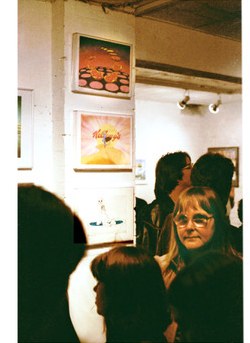
The Animation Show
April 1981 · Exhibition · Neal Street Gallery, London
Group exhibition
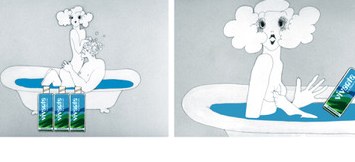
Original artwork from Marjut's Vivante and Kellogg commercials was shown in this group exhibition at the Neal Street Gallery in Covent Garden.
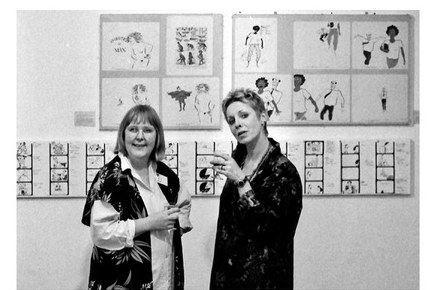
Film & Strip
2 November 1985 · Exhibition · Kettle's Yard Gallery, Cambridge
Group exhibition, part of the Cambridge Animation Festival
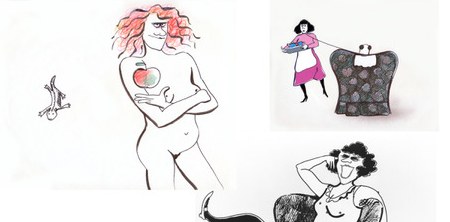
A group exhibition, Film & Strip, at Kettle's Yard Gallery as part of the Cambridge Animation Festival in November 1985. It showed original artwork from I'm not a Feminist, but… and later toured around Britain.
Get in touch
For festival and screening enquiries, teaching, masterclasses, or correspondence: